Ofsted Inspection… by @ASTSupportAAli

Fascinating , honest account . Thanks for sharing

@TeachLeadAAli's avatarNewToThePost

*UPDATED*

Wednesday the 28th and Thursday the 29th of January 2015. Two important days in my Senior Leadership career. These two days saw my school receive a full Section 5 Ofsted Inspection. In this short blog I would like to share some tips/observations and reflections about the inspection and its process both as a school and a member of SLT.

The call:

Tuesday, around 13.30pm, I was summoned by a frantic looking member of support staff to go to meet other SLT in our meeting room.

‘Where were you? I have been looking everywhere for you!’

My response’s tone couldn’t have been more opposite,

‘Hi, I have been running an annual review, as per my calendar. Why what’s the panic!?’

I replied with a beaming smile.

Usually what would have happened if somebody was searching for me is they would radio for me. If no luck, they would call…

View original post 2,038 more words

Teaching toddlers British Values

Teaching British values to toddlers will be tough to enforce


from The Conversation 

The Conversation

speaking volumes

By Jacqueline Baxter, The Open University

The recent announcement by the new secretary of state for education Nicky Morgan that toddlers must be taught British values is the latest in a chain of events precipitated by the Trojan Horse affair over extremism at some schools in Birmingham.

But awareness of equality and diversity issues has been central to early years education for years now. Many early years teachers already underpin their teaching with these values –values that will now be tagged as “officially British”. The big question is how Ofsted, the schools inspectorate, will interpret and police the way these values are taught to toddlers.

Following on from recent changes to the School Inspection Handbook – largely instigated following the Trojan Horse affair – the government has launched a consultation into changes to the school and early years finance regulations. Crucially, this proposes that funding be withdrawn from providers that do not “actively promote fundamental British values”.

Going over old ground?

But experts argue that the definition of these values – learning right from wrong, to take turns and sharing – are values that have been fundamental to early years provision for a considerable amount of time. This position was emphasised by Neil Leitch, chief executive of the Pre-School Learning Alliance in a recent interview on the proposed changes.

This view is also supported by Sue Griffin, former national training manager for the National Childminding Association and author of Inclusion, Equality and Diversity in working with children. She told me, “Early years settings have a lot to teach the education sector and right wing politicians about addressing inclusion, equality and diversity, since practitioners with our youngest children have been exploring these issues for decades.”

She went on to emphasise the need for practitioners “to keep their nerve and carry on in the confidence that they are thinking seriously about practical ways of helping children to develop unprejudiced views and learn to respect and value one another, whatever their differences in ethnicity, culture, family background.”

What are British values?

There is little dispute around the actual values being advocated by government, but the insertion of the word British and its apparent annexation of these values is, for many, deeply disturbing.

The term British on its own is difficult to define. There is no single definition of what it means to be British as historian Paul Ward points out in his book on Britishness since 1870. He highlights the fact that Britishness is not innate, static or permanent and has been mediated by many identities, not least race, colour, gender and class.

If we can’t define British, then British values are even more nebulous to pin down as educationalist Gus John describes:

David Cameron and people like me see the world through different eyes. We see our combined history through different lenses and therefore I have a take on the legacy of Empire and what Britain should have been doing about these last 50 years that differs fundamentally from that of Mr Cameron and the roots of his ‘British values’.

It seems bewildering to some professionals in this area that the government should seek to make such a provocative statement about British values. Liz Bayram, chief executive of the Professional Association for Childcare and Early Years said that the existing early years curriculum “already requires nurseries and child-minders to develop key skills such as teaching children to take turns and challenge negative attitudes”.

She goes on to say that Ofsted already has the power to judge values under the Early Years Foundation Stage and can already, “tackle concerns by judging a setting as requiring improvement”. Bayram calls the innovation “a big reaction to an issue that may not even be there, and that could be tackled by the inspection framework that is already in place”.

Creating policy on this matter is one thing but it is quite another when it comes down to putting it into operation. Asking inspectors to define what a British value is and what is not will add a very tricky element to their training. This is already overloaded with the numerous requirements demanded of practising inspectors, not only in the act of inspection itself but equally in post-inspection reporting to the public. They will need to explain exactly how they came to their judgements on this issue.

The guidance contained in the School Inspection Handbook comes into force this September. It remains to be seen how Ofsted will deal with this latest turn in the complex business of regulating English education, and the early years sector will no doubt look on with interest.

The ConversationJacqueline Baxter does not work for, consult to, own shares in or receive funding from any company or organisation that would benefit from this article, and has no relevant affiliations.

This article was originally published on The Conversation.
Read the original article.
School governors how we got here and where we go from here

The recent crisis in English Education, nicknamed Trojangate by bloggers and tweeters,(Phipps, 2014), has brought to light some of the acute issues facing school governance in England today. The affair prompted by a letter which is now thought to be a hoax, has prompted an unprecedented level of school inspections, carried out to investigate the alleged infiltration of hard line Muslim ideology into the curriculum of 25 Birmingham Schools an infiltration which was alleged to have taken place largely due to mismanagement of school governors. As a result, five of the schools were placed in special measures, the lowest school inspection category available, with a further nine schools re-categorised to ‘requires improvement’. The scandal, amongst other factors has brought to light issues with the whole issue of school governor operations and their role in overseeing in what is essentially a new education system in England (Baxter, 2014a).

Although The Trojan Horse Affair has placed school governance firmly in the eye of the media, the whole area has been under scrutiny for some time now. Recent parliamentary enquiries, reports by the English Inspectorate of Education, Ofsted (The Office for Standards in Education, Children’s Services and Skills), have all questioned how a system which has grown organically over the past hundred years, is to be monitored and governed given the many and varied changes to English school structures that began under New Labour and have continued to gain pace under the present Coalition Government from 2010 (Ofsted, 2011; Parliament, 2013b, 2013c).
In order to understand what the current challenges are, it is important to understand how the system of education governance has evolved. Particularly as it is a system which is in many ways unique to England, evolving as it has in response to both educational and political imperatives that are particular to that country (Lawton, 1978; Sallis, 1988b)
School governance actually dates back some 600 years, and were first introduced to ensure financial probity as Joan Sallis describes here:
They [governors] ‘ were charged to scrutinise teaching and progress in school of the scholars and the quality of the food provided for the same…and shall correct or reform anything needing correction or reform.’(Sallis, 1988b:100)
Two major enquiries: The Clarendon Commission in 1861 and the Taunton Commission in 1864, centring on public schools and grammar schools respectively uncovered that many of these schools had drifted from their original purposes and proposed that a new form of accountability be created: the governing body. The proposals were formalised in the form of two Acts, the Public Schools Act and the Endowed Schools Act (Parliament, 1868a, 1868b). Of these reports The Clarendon report went furthest in describing the duties of governing body and head teacher. Outlining the way in which the curriculum was structured the report pointed to the way in which governors were expected to influence:
‘What should be taught, and what importance should be given to each subject are therefore questions for the Governing Body; how to teach is a question for the head master.(Commission, 1864)
The shape and format of governing bodies continued to evolve until the 1944 Education Act laid down the partnership between central and local government and set out in some detail, the roles and responsibilities of governors and the division of responsibilities between the LEA and individual school bodies (Parliament, 1944). The act changed the shape and form of governing boards, increasing their powers and specifically articulating their modus operandi in sections 17 -21. But although the 1944 act demanded that all schools should possess a governing body, in terms of governing schools the act was seen by some to lack substance, as Sallis outlines,
‘The Act’s provisions on school governance were an attempt to graft firmly onto the state system of education a model which has been devised for the public schools and in which the Victorian figure of the ‘local worthy’ loomed large.[…] perhaps was inevitable that managers and governors either became meaningless appendages of the schools or mere tools of providing authority.’(Sallis; 1988:110).
After that the most substantial changes in the form and shape of school governance emerged during the early sixties. Prompted by the changing system of education the parental element of school governing gained pace, spurred on by the rise of parent groups .The National Association of Managers and Governors established in 1970 was established in order to reform outdated systems of school governance established by the 1944 Act. But the pace of change would have been far slower had it not been for the radical and transformative work done in the City of Sheffield in the late sixties. This was largely due to innovative Labour policy initiatives prompted by an extended period out of office. When Labour returned to power in 1970 it returned with a pledge to,
‘Work for a more participatory style of local democracy, with encouragements to tenant’s associations, consultation with these and other non-political support groups and community based individual governing boards for all schools.’ (Sallis:114).
Considerable changes in Sheffield resulted in a far larger more participatory articulation of school governance. Numbers of governors rose dramatically and the impact of the reforms gave rise to the Taylor Inquiry, which instigated the Taylor Report (1977), arguably one of the most influential reforms on school governance since the 1944 Act .
It was felt that although the 1944 Act had articulated certain understandings of governance, that it did not go far enough and had become outdated. The Taylor Report recommended that five main interests should be represented on governing bodies: the LEA, parents, teachers, older pupils and the local community. In addition it recommended that all LEAs provide training and development for governors. The report was well received, not least due to the fact that in sentiment it reflected the far greater focus on participation in education in terms of home support for children and a greater role for the community in supporting local schools. The report focused on the local element of governance in a number of ways, but one of the principal elements of this was the need for. ‘Governors not to be accountable to their transient clientele, but rather act as guardians of the school’s distinctive place in the local system and as participants of a healthy local system’ (Ibid:10). The report was shortly followed by The Education Act 1980 which allowed any governor to stand for Chair (not just LEA governors). The 1986 Education Act (NCC, 2001) concentrated its efforts on partnership between central and local government ensuring the end of the dominance of governing bodies by LEA representatives, strengthening the role of governors reporting to parents and highlighting the role of individual schools. Although this Act seems almost to have been forgotten in the wake of the 1988 Act; for governors it was an important one in terms of highlighting their role in linking school with community: a facet all but negated in the later act. The return of the Conservative Party to power in 1987 combined with the teachers dispute which took place from 1985 -6 , created a great deal of dissatisfaction with the perceived power of the teaching profession, creating a need to control and regulate to a far greater extent than previously.
Following the 1988 Education Reform Act (Parliament., 1988) there was increasing emphasis on school self-management. The principal impact of The Act on governance was the introduction of Local Management of Schools (LMS). This effectively devolved all responsibility for the budget and the management of school staff into the hands of governors. Some governing bodies opted to take this further, by adopting Grant Maintained status becoming the employers of staff with an extended decision making function. This resulted in a far greater impetus for schools to engage governors from the business community an element described in Thody’s 1994 study on school governors which describes, ‘An advice book for business community governors that, ‘schools need to run like companies with the governing bodies being boards of directors and the headteachers the managing directors (Thody, 1994:22).
The three challenges of a changing system

Today’s school governor is faced with a number of issues, not least of these, the ways in which the education landscape has changed and evolved over the past 20 years. The Academies project, a flagship policy instigated by the New Labour Government under Tony Blair was set up to improve failing schools by offering them financial and a certain degree of curricular independence (Ball, 2009). In 2010 the project was intensified and widened by the Academies Act 2010 (Parliament, 2010).Under the new regulations, outstanding schools too could opt for academy conversion. Since the Conservative Liberal Coalition Government came to power, the Act has been used to progress a neo-liberal belief in the efficiency of the market by using the powers of Ofsted and The Secretary of State for Education- Michael Gove to force academisation on failing schools (Gorard, 2009).Governors in these schools- over 4000 at the last count (DFE, 2014). Within these schools there is currently no middle tier of accountability between volunteer school governors and Gove. The second key issue facing governors is the increasing incursion of groups of schools, either chains or federations which operate very different governance structures to single schools. In some cases governors may be responsible for a number of schools, supported by local governing groups who have consultative but no decision making powers- this has raised questions over what it really means to be a school governor (see for example Baxter & Wise, 2013; Chapman et al 2010). The third major challenge for school governance arises from the increased regulatory emphasis placed upon it by the English School Inspectorate, Ofsted (The Office for Standards in Education, children, families and skills).

School governing grew organically but in the government’s haste to create a new education system it seems to have been assumed that the governance system could be cut and pasted on without any problems. Trojan Horse if anything positive has come out of it, has proved that this is clearly not the case.

For further information see the full article at :
https://www.academia.edu/7701386/School_Governor_regulation_in_Englands_changing_education_landscape_Is_it_a_case_of_MADSchool_Governor_regulation_in_Englands_changing_education_landscape_Is_it_a_case_of_MAD

Ofsted’s future at stake after Trojan Horse scandal


profile picture the convers (1 of 1)


See the full article by clicking the link below :


https://theconversation.com/ofsteds-future-at-stake-after-trojan-horse-scandal-25936

Heaping on pressure won’t attract new school governors -New Post

Click the link to read what the problems are ………….

Heaping on pressure won’t attract new school governors

profile picture the convers (1 of 1)


Naming, framing and shaming: the role and function of the legacy media on education and inspection policy in England.

Naming, framing and shaming: the role and function of the legacy media on education and inspection policy in England.


Abstract

The role of the media on international education policy has been recognised for some time now (Anderson, 2007); not least in terms of the often powerful impact it exerts not only on education policy but on public service policy more generally (Hall, 1997; Wallace, 1994; Wallace, 1996). Education inspection is now employed by a number of countries both within and outside of Europe, to govern complex education systems (Ozga, Baxter, Clarke, Grek, & Lawn, 2013) In England in common with other OECD countries (see Rönnberg et al, 2012), school inspection is the focus of a great deal of media attention, particularly since the inception of the current inspectorate, Ofsted, in 1992. Since The Conservative /Liberal coalition took power in 2010, the media has increasingly been used to criticise the extent to which the inspectorate is being used to fulfil the government’s education agenda; raising questions about the extent to which its judgements can be said to be impartial (Baxter, Rönnberg, & Ozga, forthcoming). This paper draws on media discourse theory (Negrine, 2013) to employ a case study approach to examine the ways in which Ofsted is used to frame debate on The Academies project  (Parliament, 2010) Sampling from 3 national newspapers: The Times, The Guardian and The Telegraph the study analyses 160 articles on inspection which make indirect and direct reference to the act. Using a framework for media analysis , it explores how media coverage of inspection within the period 2009 to 2014 is framed in terms of the act (Baxter, Ozga, & Rönnberg, Forthcoming ) .The research questions examine: how the media shape their coverage in order to appeal to the public; what news values are employed in order to colour and condition stories in ways that make them acceptable and persuasive to the public; and finally : how news stories are cognitively framed in order to create links between education policy and public understandings. The paper concludes that in linking inspection to this policy, the media exert considerable influence upon the ways in which this policy is understood and received by the public.

‘All that matters now is , the media , the media , the media’ Prime Minister Tony Blair on his election to Leader of the Labour Party.

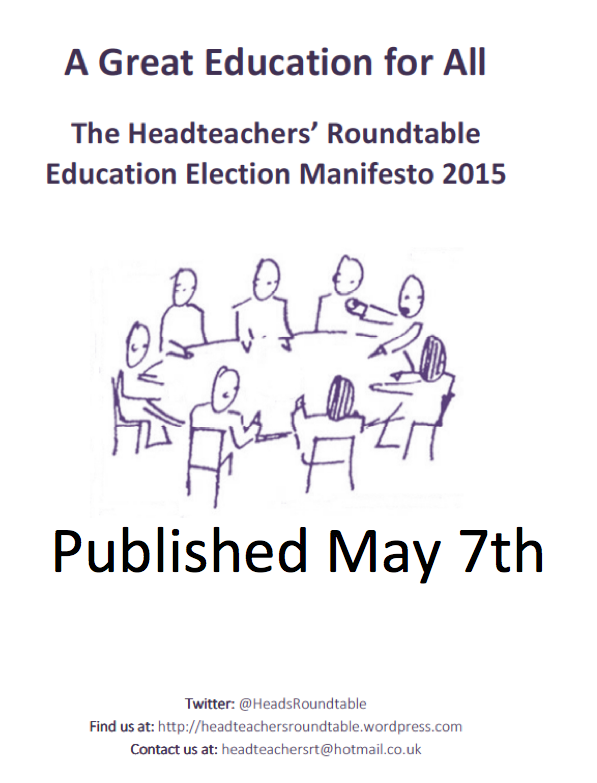
The HTRT Education Manifesto Launch May 7th

headteachersroundtable's avatarHeadteachers' Roundtable

Screen shot 2014-05-01 at 22.19.31

Following the process outlined earlier this year, we received over 50 responses from different people making suggestions for policies and for some of the principles that should guide us.  Taking those ideas on board and adding them to our own, we have now produced a 10-proposal manifesto, covering five key policy areas. Although deliberately sparse, we believe that our proposals represent a coherent roadmap for a system that provides A Great Education for All.

We will be publishing the manifesto on May 7th, one year before the General Election in 2015. You will find it here on our website. Once published, we’re hoping that people engage with the ideas and help us to develop the implementation plans that will follow, leaving comments with constructive suggestions.

We’ve had a commitment from the Secretary of State that he will engage with the manifesto and give us his response.  We discussed this…

View original post 39 more words

Ofsted’s Future in the balance after Trojan Horse Scandal

Ofsted’s Future in the balance after Trojan Horse Scandal

See my last  blog post on The Conversation Com. 

School Inspection

Find below, the link to the presentation
Wednesday, 21 May 2014, 10:30 – 17:00

https://www.open.ac.uk/ccig/events/governing-by-inspection-insights-from-international-studies

An event that examined school inspections across Europe

School inspection is employed in a number of countries as a means by which to govern increasingly complex education systems. Despite a tenuous link between inspection and school improvement, it remains a key driver in the shaping and implementation of education policy, as well as taking a central role in the politics of educational change.

This seminar drew on three national and international research projects in order to examine perspectives on school inspection in Europe. The first project: Governing by Inspection investigates inspection as a governing practice in England, Scotland and Sweden; the second, explores the relationship between school improvement and inspection in  six countries, and the third investigates accountabilities in inspection. You will find the slides and recording of the talks on the link above

10:00-10:30  Registration and coffee

10:30-10:40  Welcome and introductions-Dr Jacqueline Baxter- Convenor

10:30-11:15  Dr Melanie Ehren – The Institute of Education: The Impact of School Inspections on Improvement of Schools

11:15-12:30  Professor John Clarke – The Open University UK: The Uncertainty Principle: governing schooling through inspection.

12:30-13:15  Lunch

13:15-14:00  Dr Andrew Wilkins – The University of Roehampton: The Shadow of Inspection: School Governance, Accountability and Governing Practices

14:00-14:15  Coffee

14:15-15:00  Dr Jacqueline Baxter – The Open University UK: Working knowledge: shifting criteria in inspection

15:00-15:15  Summary and Close


CCIG Presentation Slides: The Shadow of Ofsted